

Time Complexity in Data Structure
Time Complexity is the crucial topic in data structure that every programmer should know. As it describes the time taken by any process in program and if you have solid understanding of time complexity then you can write and use the data structures efficiently.
Time Complexity
In simple term time complexity is the notation which is used to represent the time which is taken by any algorithm to procedure it's task based on given input
Larger input -> Longer time
Small input -> Short time
There are mainly two types of algorithms
- Runs on constant time O(1) (Big Oh of 1)
- Time depend on the number of input O(n) (Big Oh of
n)
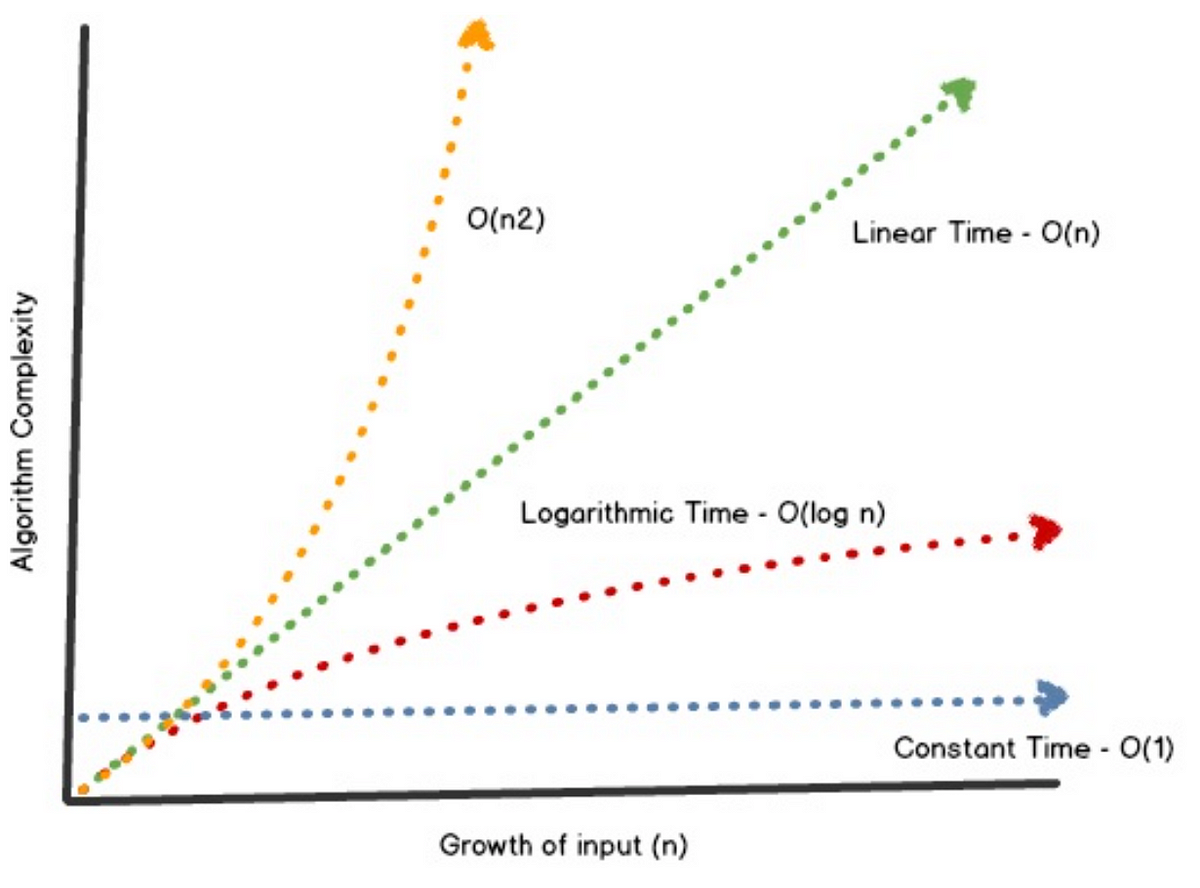
Below graph represents the slopes of different notations
Consider the example
Below noted table shows the time taken by two different algorithm for sorting an array
| No. of elements | Algorithm 1 | Algorithm 2 |
|---|---|---|
| 10 | 90ms | 122ms |
| 80 | 110ms | 124ms |
| 150 | 180ms | 131ms |
| 1400 | 2s | 800ms |
What do you think which algorithm is better ?
Well it totally depends on the useCase
for longer list Algorithm 2 is better as it runs on constant time and for shorter list Algorithm 1 is better which runs on linear time
Notations ranks based on time which they consumes
- O(1) Constant time <------------------Best
- O(log ₙ) Log base n time input
- O(n) Linear time
- O(n²) Double the linear time <----------------Worse
There are many more notations but these are common notations which are used widely
Note
In time complexity we ignore the non dominant term which doe'nt affect on overall calculation e.g. Declaration of variables
Calculating time complexity
consider the example which adds element in array in c language.
// constant time k
int a = 0;
int arr[10];
// calculation time f(n)
for (int i = 0; i < 10; i++)
{
    arr[i] = i + 1;
    printf("Element %d\n", arr[i]);
}
The time complexity of above code is O(n) as the time taken to add element in array depends on variable b
Output of above snippet
Element 1
Element 2
Element 3
Element 4
Element 5
Element 6
Element 7
Element 8
Element 9
Element 10
Quick quiz
What is the time complexity of given code
int a = 0;
int b = 10,c = 20;
int arr[b],arr1[c];


for(int i = 0; i < b; i++)
{
    arr[i] = i+1;
    printf("Element in arr 1: %d\n",arr[i]);
}

for(int j = 0; j < c; j++)
{
    arr1[j] = j+1;
    printf("Element in arr 2: %d\n",arr1[j]);
}
and of this one
int k = 10;

for(int i = 0; i < k; i++)
{
    printf("\nValue of i = %d\n",i);
    // Performs some complex tasks apart printing
    for(int j = 0; j < k; j ++)
    {
        // Performs some complex tasks apart printing
        printf("Value of j = %d",j);
    }
}
Answers
First one: O(n)
Explanation:
The both loops are independent and they both takes same amount of time O(n) but we can't represent time in 2*O(n)
Second one: O(n²)
Explanation:
The first loop takes time O(n) while the loop inside the first loop also takes time of O(n), therefore O(n) + O(n) * n = O(n²)